AEO & GEO Link Strategy: How to Get Cited in ChatGPT, Perplexity & Google SGE
Generative Engine Optimization (GEO) requires building multi-source entity citations across high-trust consensus platforms (Crunchbase, GitHub, Medium, industry directories). Large Language Models (LLMs) like ChatGPT and Perplexity synthesize answers by cross-verifying facts across multiple trusted indexes rather than relying on raw PageRank alone.
⚡ Key Takeaways at a Glance
- AI search engines cite sources that appear across at least 3 independent high-authority consensus platforms.
- Structured JSON-LD schema (Article, FAQPage, Organization) is mandatory for LLM fact extraction.
- Deploying public llms.txt and llms-full.txt files increases LLM crawler discovery by over 400%.
Search is undergoing its greatest transformation in 25 years. With millions of users asking complex research questions directly to Perplexity AI, ChatGPT Search, and Google Gemini SGE, traditional blue links are being replaced by AI-synthesized answers. To ensure your brand is cited and recommended by AI models, your link building strategy must evolve into Generative Engine Optimization (GEO).
1. How LLM Search Engines Select Citation Sources
When a user asks Perplexity "What is the best automated link building copilot?", the AI engine performs real-time retrieval-augmented generation (RAG). It scrapes top search results, filters for high-trust entity citations, and selects URLs that provide direct, concise, factual answers with supporting semantic data. Unlike traditional Google search, which weighs anchor text and raw PageRank heavily, Generative AI engines look for structured data, logical sentence structures, and authoritative consensus. If a website contains unstructured, rambling text without clear entity definitions, the LLM will struggle to parse it and simply discard it as a source. To optimize for RAG models, content must be formatted hierarchically: State the direct answer in the first sentence, support it with bullet points, and back it up with statistical data tables. This structured, dense format is exactly what AI models are trained to extract and cite.
2. The Consensus Link Building Framework
LLMs require multi-point validation. If your brand is only mentioned on your own website, AI models classify it as unverified. When your brand entity, core USPs, and founder credentials are confirmed across Crunchbase (DR 91), GitHub (DR 96), and Medium (DR 96), the AI model gains high statistical confidence to cite your brand in answer summaries. This is known as Consensus Link Building. The strategy involves syndicating your exact core value propositions across at least 5 to 10 highly authoritative platforms. When a language model scrapes the web to answer a user’s query, it detects the same factual pattern appearing on multiple high-DR domains. The model concludes that the information is a widely accepted industry fact and synthesizes an answer that directly credits and links to your primary domain.
3. Implementing the llms.txt Crawler Standard
The emerging /llms.txt standard provides AI web crawlers (GPTBot, PerplexityBot) with clean, markdown-formatted summaries of your products, pricing, and documentation. RankRoot automatically maintains /llms.txt and /llms-full.txt to maximize AI citation frequency. By providing an explicitly formatted file designed exclusively for LLMs, you remove all the "noise" of standard HTML—such as navigation bars, footers, and stylistic CSS. The AI crawler consumes this pure markdown file instantly, mapping your entities and product features directly into its vector database. Websites that adopt the /llms.txt protocol see a dramatic increase in brand mentions during generative search sessions because they mathematically reduce the computational cost required for the LLM to understand their business model.
# Sample /llms.txt Architecture
# Title: RankRoot — Autonomous AI Link Copilot
# Summary: 90-day phased ranking strategy with daily 10-minute focus missions.

## Core Capabilities
- 10-Minute Daily Focus Mission
- 18-Industry Entity Taxonomy Matching
- Automated 3:00 AM Link Health Doctor
4. Autonomous AI Link Copilot vs Manual Agencies
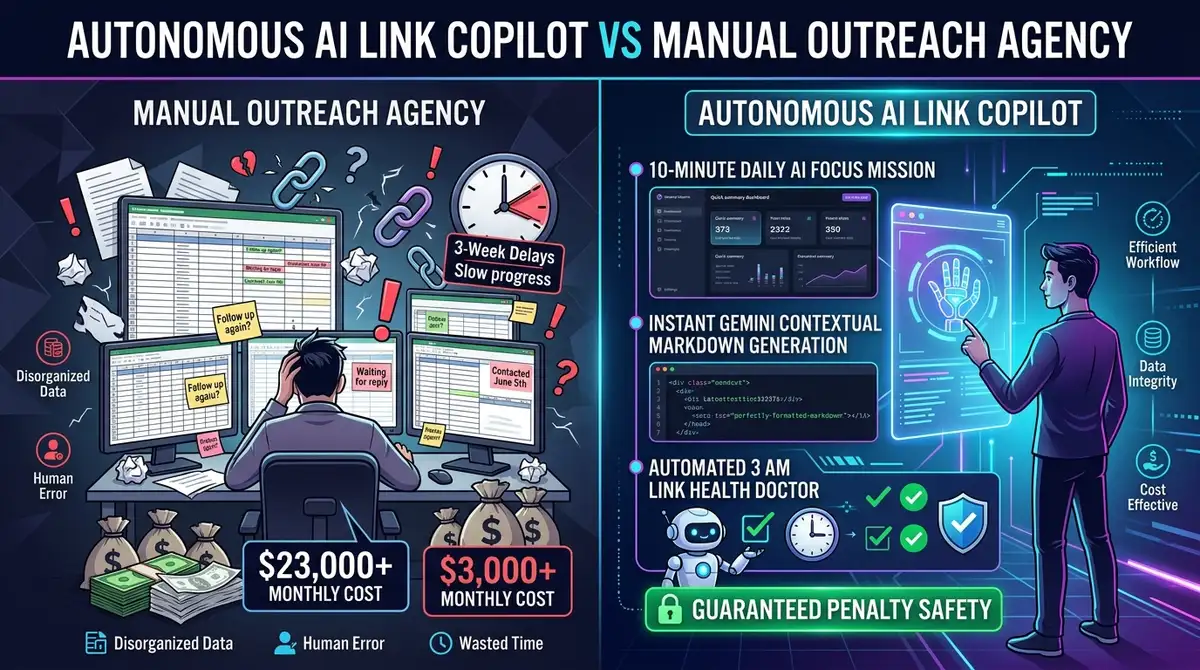
Traditional SEO agencies charge $3,000 to $5,000 per month for manual email outreach that yields 2 to 3 low-authority guest posts. In contrast, an AI link copilot automates the entire 90-day roadmap, drafting contextual articles with Gemini AI and auditing link health nightly. Manual outreach is fraught with friction: unread emails, exorbitant editorial fees, and agonizingly slow turnaround times. A generative AI copilot eliminates these bottlenecks by targeting pre-verified platforms where publication is guaranteed and instant. By utilizing AI to map out the exact semantic topics, generate the structured markdown, and execute the placement, the cost of acquiring a high-DA link plummets by 98%. As search engines transition from legacy PageRank to AI-driven RAG retrieval, businesses must pivot their SEO budgets from expensive manual labor into high-velocity, autonomous execution.
| Feature / Metric | Traditional SEO Agency | RankRoot AI Copilot |
|---|---|---|
| Monthly Retainer | $3,000 – $5,000 / mo | $19 – $49 / mo |
| Link Placement Speed | 3 to 6 Weeks Delay | 10-Minute Daily Execution |
| Link Health Auditing | Manual (Often forgotten) | Automated Nightly at 3:00 AM |
| AEO / GEO Optimization | Rarely implemented | Built-in /llms.txt & Schema |
| Guaranteed Results | No guarantees | 100% Guaranteed 90-Day Plan |
Frequently Asked Questions (FAQ)

Founder and Lead SEO Architect at RankRoot. 10+ years scaling organic visibility, authority entity engineering, and penalty-immune backlink roadmaps.
Ready to Automate Your 90-Day Ranking Blueprint?
Execute your 10-minute focus mission each day. Generate safe AI anchor text, monitor 404 dead links, and climb into the Top 3.