Google Penguin Anchor Text Ratios: The Mathematical Safety Rule for 2026
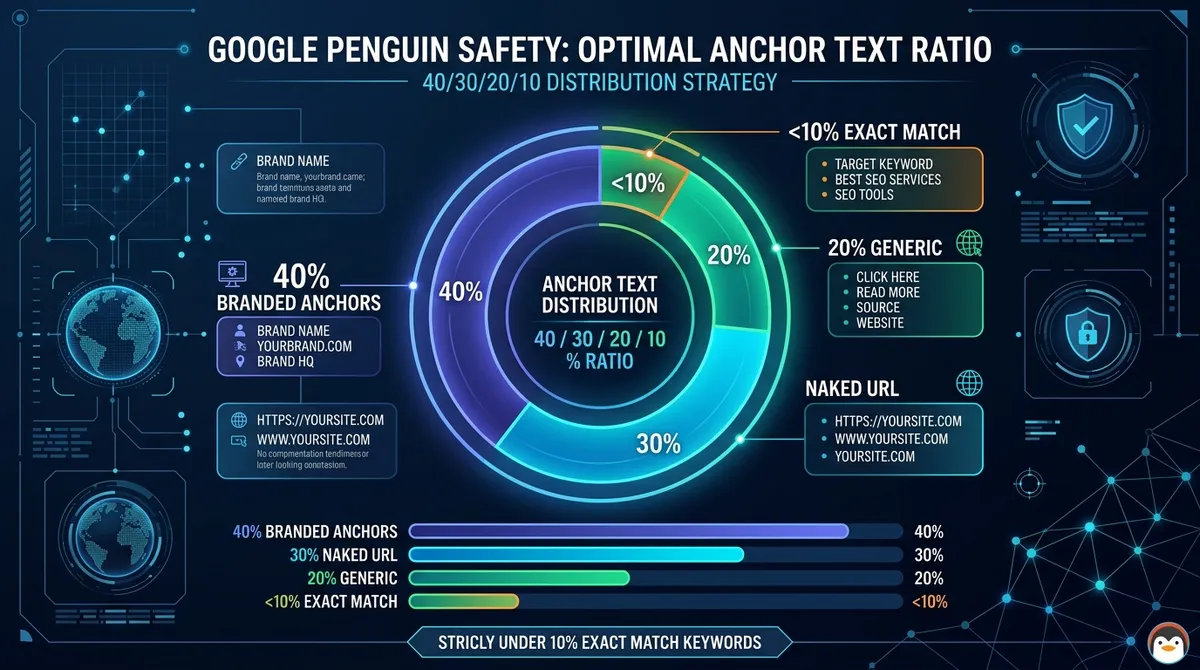
The safe Google Penguin anchor text formula in 2026 enforces the 40/30/20/10 ratio: 40% Branded anchors, 30% Naked URLs, 20% Generic & Semantic anchors, and strictly under 10% Exact Match commercial keywords. For new domains with Domain Rating under 30, exact match anchors should remain under 5% to prevent algorithmic suppression.
⚡ Key Takeaways at a Glance
- Exact match anchor text exceeding 10% of total links is the #1 trigger for algorithmic link spam penalties.
- Google SpamBrain analyzes semantic co-occurrence around the anchor, not just the linked text.
- Always use your Brand Name or Naked Domain when building links on directories and social entity profiles.
- Audit your backlink inventory weekly to detect and correct "anchor drift" before algorithm updates roll out.
Anchor text is the clickable text in a hyperlink. For over two decades, search engines used anchor text as a primary relevance signal to understand what a destination webpage is about. However, because manipulative SEOs over-optimized commercial keywords, Google introduced the Penguin algorithm to aggressively penalize domains with unnatural anchor text distributions.
1. The Anatomy of an Anchor Text Penalty
When Google detects that a site ranking for "best solar calculator" has 40% of its incoming backlinks using that exact four-word phrase, its statistical anomaly filters flag the domain for artificial manipulation. Natural link growth always produces an overwhelmingly branded and naked profile because real humans refer to businesses by name or by pasting their web address. Historically, Google’s Penguin update fundamentally shifted the SEO landscape by penalizing domains that exhibited these artificial commercial link profiles. Today, SpamBrain’s neural network extends this by understanding the semantic co-occurrence around the link itself. If your exact match anchors dramatically outpace your branded anchors, you are essentially waving a red flag at Google’s webspam team. A penalty can result in complete de-indexation or a severe algorithmic dampening where your site is perpetually stuck on Page 5 regardless of how many new links you acquire. Erring on the side of caution with anchor text is the most critical defensive SEO strategy you can deploy.
2. The 5 Distinct Anchor Text Classifications
Every single backlink in your profile falls into one of five categories. Understanding these definitions is essential before placing any new link. Branded anchors refer strictly to your company name, while Naked URLs are simply the raw web address. Generic anchors are contextual phrases like "read more" or "click here." Partial Match anchors combine a brand name with a keyword, acting as a safe middle ground. Finally, Exact Match anchors are raw commercial search terms without any branded elements. The ratio in which you deploy these five types determines whether your domain builds authority or triggers a penalty.
| Category | Definition | Real-World Example | Safe Ceiling |
|---|---|---|---|
| Branded | Exact brand or company name | "RankRoot", "RankRoot Copilot" | 40% – 50% |
| Naked URL | Raw web address with protocol or www | "rankroot.app", "https://rankroot.app" | 25% – 30% |
| Generic | Non-topical call to action or reference | "click here", "source", "official website" | 15% – 20% |
| Partial Match | Brand name combined with keyword | "RankRoot SEO copilot", "learn link building at RankRoot" | 10% – 15% |
| Exact Match | Target commercial keyword with no brand | "link building software", "free backlinks" | <10% (<5% for DR<30) |
3. The 40/30/20/10 Golden Distribution Rule
To construct an unshakeable link profile, maintain the 40/30/20/10 budget: for every 10 backlinks you build, ensure 4 are branded, 3 are naked URLs, 2 are generic or semantic co-citations, and at most 1 utilizes a targeted keyword anchor. This distribution mirrors the organic linking patterns of Wikipedia, Amazon, and other authoritative domains. By anchoring the vast majority of your inbound links to your brand identity, you establish immense topical trust. When you eventually deploy that one exact match anchor on a high-DA platform like Medium or GitHub, its ranking power is amplified tenfold because Google views it as a natural, highly relevant citation rather than a manipulated keyword injection.
4. How Anchor Drift Occurs and How to Fix It
Anchor drift happens when multiple outreach articles or forum answers accidentally use the same target phrase over a short period. If you submit 3 articles using the same commercial anchor in a week, your exact match ratio can spike from 7% to 18%, putting your domain in the danger zone. This frequently occurs when SEO teams lack centralized tracking, leading different writers to default to the same high-volume keyword. To combat this, you must conduct weekly audits of your referring domains. If you detect anchor drift creeping past the 10% threshold, immediately pause all commercial link building. Counteract the imbalance by executing a rapid deployment of Phase 1 entity citations—such as Crunchbase, About.me, and local directories—using exclusively branded and naked URL anchors to dilute the commercial ratio back into the safe green zone.
If your exact match ratio exceeds 10%, build 5 consecutive Phase 1 branded entity citations (e.g. Crunchbase, About.me, Pinterest) to dilute the ratio back into the green safety zone.
5. Anchor Safety Rules Adjusted by Domain Authority
Older, high-authority websites (DR 60+) possess substantial historical trust and can tolerate up to 12% exact-match anchors. Conversely, fresh websites (DR 0–25) have zero algorithm trust buffer. For new websites, exact-match anchors must stay strictly below 5% until the site reaches 50+ unique referring domains. Google’s algorithms are highly suspicious of new domains that immediately acquire commercial keyword links before establishing a branded entity footprint. As your Domain Rating increases and your site matures, the algorithm grants a larger "trust radius," allowing you to slightly increase your partial and exact match ratios. However, a conservative approach is always recommended. When in doubt, default to a branded anchor; brand authority eventually translates into commercial ranking power.
Frequently Asked Questions (FAQ)
Does Google penalize nofollow backlinks for exact match anchor text?
Nofollow backlinks carry substantially lower risk of manual penalty, but SpamBrain still evaluates them to determine whether an entire profile is engaged in artificial commercial link schemes.
How do I check my current anchor text ratio for free?
You can use our Free Anchor Text Auditor tool (/tools/anchor-text-calculator) to paste your backlink export and instantly see your exact percentage breakdown across the 5 anchor buckets.

Founder and Lead SEO Architect at RankRoot. 10+ years scaling organic visibility, authority entity engineering, and penalty-immune backlink roadmaps.
Ready to Automate Your 90-Day Ranking Blueprint?
Execute your 10-minute focus mission each day. Generate safe AI anchor text, monitor 404 dead links, and climb into the Top 3.