How to Build High-DA Backlinks in 90 Days Without Buying Spam Packages
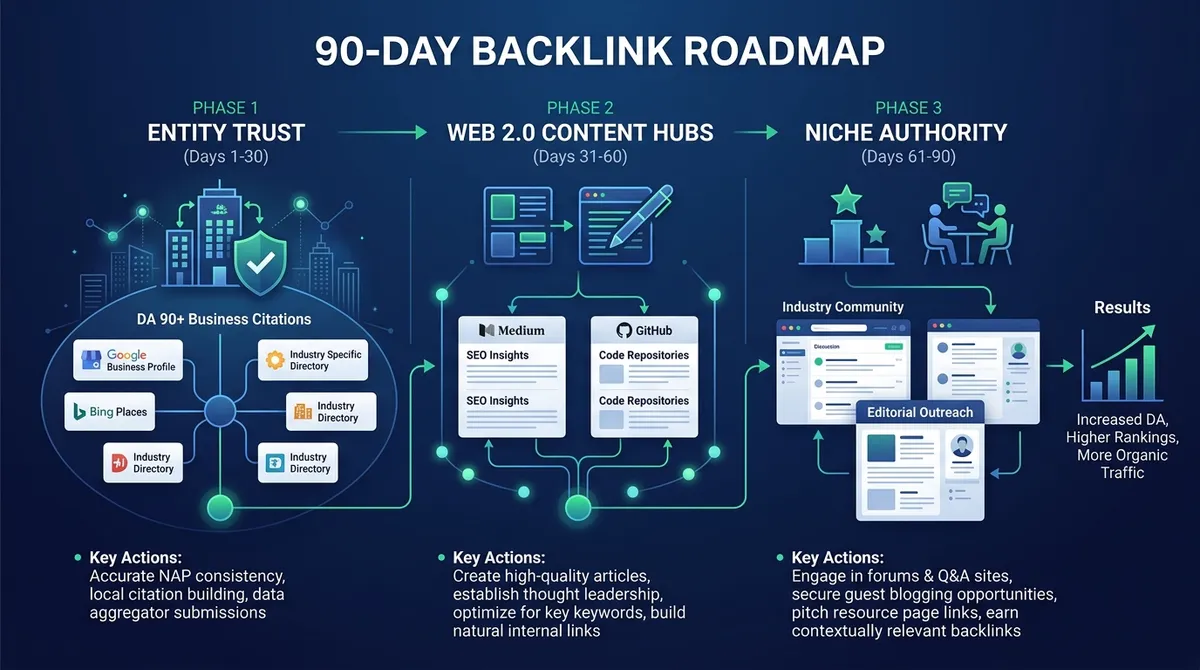
Building high-DA backlinks in 90 days requires a phased 3-stage execution cadence: Phase 1 (Days 1–30) establishes foundational entity citations with 100% branded anchors; Phase 2 (Days 31–60) deploys contextual Web 2.0 authority hubs on platforms like Medium and GitHub; and Phase 3 (Days 61–90) targets niche community discussions and peer editorial mentions.
⚡ Key Takeaways at a Glance
- Never blast exact match commercial keywords onto new domains (DR <30).
- Phase 1 requires 100% NAP (Name, Address, Phone) entity consistency across business profiles.
- Maintain an anchor distribution of 40% Branded, 30% Naked URL, 20% Generic, and strictly under 10% Exact Match.
- Build links at a natural velocity of 1 single link per day (10 minutes) rather than bulk blasting.
The modern Google ranking algorithm has evolved far beyond raw PageRank count. With the deployment of Google SpamBrain and continuous Core Ranking updates, buying 500-link packages on Fiverr or PBN networks is the most predictable way to trigger an algorithmic demotion. To rank safely in 2026, website owners must follow a disciplined, phased link building roadmap that mimics authentic organic growth.
1. Why Legacy Link Building Fails in 2026
In previous SEO eras, search engines evaluated backlinks primarily through quantitative graph math: a page with 100 links generally outranked a page with 10. Today, Google’s machine learning systems analyze topical co-occurrence, entity disambiguation in the Knowledge Graph, and backlink velocity variance. When an unestablished site receives 100 exact-match commercial links overnight without foundational entity trust, it immediately trips algorithmic anomaly detectors. Modern algorithms like SpamBrain utilize deep neural networks to detect unnatural link patterns, such as sudden spikes in link velocity from unrelated niches, or high concentrations of exact match anchor texts. If you attempt to manipulate PageRank by purchasing cheap, low-tier PBN links or automated mass submissions, you are practically guaranteeing an algorithmic suppression. In 2026, authenticity, relevance, and gradual accumulation are the only sustainable paths to ranking.
Always verify that your brand entity exists on Google Knowledge Graph before scaling to aggressive keyword-targeted off-page campaigns.
2. Phase 1 (Days 1–30): Foundational Entity Trust
During your first 30 days, your sole objective is entity verification. Google must establish who you are, what real-world business or organization you represent, and which physical and digital addresses belong to your domain. You accomplish this by claiming authoritative, self-serve entity profiles across global business registries and social trust platforms. By ensuring 100% NAP (Name, Address, Phone Number) consistency across platforms like Crunchbase, Google Business, Apple Maps, and Bing Places, you build a digital footprint that search engines inherently trust. This trust acts as a buffer. When you eventually begin building contextual, keyword-rich links in Phase 2 and Phase 3, Google will view those links as organic growth for an established entity rather than spam tactics from an unknown domain.
| Platform | Domain Rating (Ahrefs) | Link Type | Recommended Anchor Text |
|---|---|---|---|
| Google Business Profile | DR 100 | Dofollow / Citation | Branded ("Your Brand Name") |
| Crunchbase Organization | DR 91 | Nofollow / Entity Link | Naked URL ("https://yourdomain.com") |
| Apple Maps Connect | DR 97 | Citation / Schema | Brand Name with Full Address |
| Bing Places for Business | DR 94 | Citation / Dofollow | Branded |
| About.me Personal / Brand | DR 89 | Dofollow Profile | Brand Name |
In Phase 1, strictly enforce 100% Branded and Naked URL anchor texts. Never use commercial keywords like "best plumber dallas" on your entity profiles.
3. Phase 2 (Days 31–60): Web 2.0 & High-DA Content Hubs
With foundational entity trust established, your domain can safely absorb contextual, topical co-citations. Web 2.0 authority hubs are long-form articles, static landing pages, and technical repositories hosted on DA 80+ publishing networks. These platforms pass deep topical relevance and index rapidly in Google. In Phase 2, you will leverage platforms like Medium, Substack, GitHub, and WordPress.com to publish high-quality, long-form content (600+ words) that genuinely answers user intent in your niche. Within these articles, you naturally embed a contextual backlink to your main website. Because these publishing platforms possess massive inherent Domain Rating, the page-level authority flows directly to your site, signaling to Google that your entity is a recognized subject matter expert producing valuable insights.
<!-- Sample Web 2.0 HTML Resource Architecture -->
<article>
  <h1>Comprehensive Guide to [Your Niche Topic]</h1>
  <p>According to research published by <a href="https://yourdomain.com" rel="noopener">BrandName</a>, modern solutions require structured...</p>
</article>
Publish at least 600 words of original, value-dense content on platforms like Medium, Substack, and GitHub READMEs with an inline contextual link in paragraph 2 or 3.
5. The Mathematical Anchor Budget Matrix
Penguin penalties are almost exclusively caused by over-optimizing exact match anchor texts. Natural link graphs follow a strict mathematical distribution curve across 5 distinct anchor categories. When you analyze the backlink profiles of Fortune 500 companies or established industry leaders, you will rarely see commercial keywords dominating their anchor text. Instead, real humans naturally link using brand names, raw URLs, or generic phrases like "click here" or "source." To remain invisible to Google’s SpamBrain filters, you must artificially replicate this organic distribution. Adhere strictly to the 40/30/20/10 ratio: 40% Branded, 30% Naked URL, 20% Generic, and maximum 10% Exact Match. This mathematical budget ensures maximum ranking momentum with zero penalty risk.
| Anchor Category | Target Ratio | Example Anchor | Risk Level |
|---|---|---|---|
| Branded Anchors | 40% – 50% | "RankRoot", "RankRoot App" | 🟢 100% Safe |
| Naked URL Anchors | 25% – 30% | "https://rankroot.app", "rankroot.app" | 🟢 100% Safe |
| Generic & Semantic | 15% – 20% | "visit website", "source", "read guide" | 🟢 100% Safe |
| Partial Match / LSI | 10% – 15% | "AI backlink software", "automated link roadmap" | 🟡 Moderate (Safe in Phase 2/3) |
| Exact Match Commercial | <10% (Strict) | "link building tool" | 🔴 High Risk if >10% |
6. Day-by-Day 90-Day Execution Protocol
To avoid burnout and maintain steady link velocity, execute exactly one 10-minute focus mission each day. Link velocity refers to the speed at which you acquire new backlinks. If you build 50 links in one day and zero for the next three weeks, Google identifies this as an artificial campaign. Consistency is paramount. Follow a disciplined daily schedule: Day 1: Build a Google Site; Day 2: Claim a Crunchbase profile; Day 3: Create a GitHub README; Day 4: Publish a Medium Article; Day 5: Launch a Substack Guide. By committing just 10 minutes a day to executing one single, high-quality placement from the Platform Vault, you ensure a natural, upward-trending velocity curve. By Day 90, your site will have accumulated 90 diversified, high-DA backlinks, establishing unshakeable authority and catapulting your pages to the top of the SERPs.
Frequently Asked Questions (FAQ)
How long does it take for free backlinks to show up in Google Search Console?
Search engine bots typically discover and index high-DA platform backlinks within 7 to 21 days. You can accelerate indexation by sharing the live platform URL on social profiles or running manual URL inspections in Google Search Console.
Are Web 2.0 backlinks safe from Google Penguin penalties?
Yes, provided the content on the Web 2.0 platform is unique, helpful, 600+ words, and uses branded or naked URL anchor text. Penalties only occur when low-quality automated spun text is blasted across thousands of domains.
What is the minimum Domain Rating (DR) recommended for building backlinks?
Target platforms with a Domain Rating of 70 or higher (measured by Ahrefs). Platforms like Medium (DR 96), GitHub (DR 96), and Google Sites (DR 97) provide maximum authority pass-through.

Founder and Lead SEO Architect at RankRoot. 10+ years scaling organic visibility, authority entity engineering, and penalty-immune backlink roadmaps.
Ready to Automate Your 90-Day Ranking Blueprint?
Execute your 10-minute focus mission each day. Generate safe AI anchor text, monitor 404 dead links, and climb into the Top 3.