Rank & Rent Local SEO: How to Dominate City Silos With Phased Entity Links
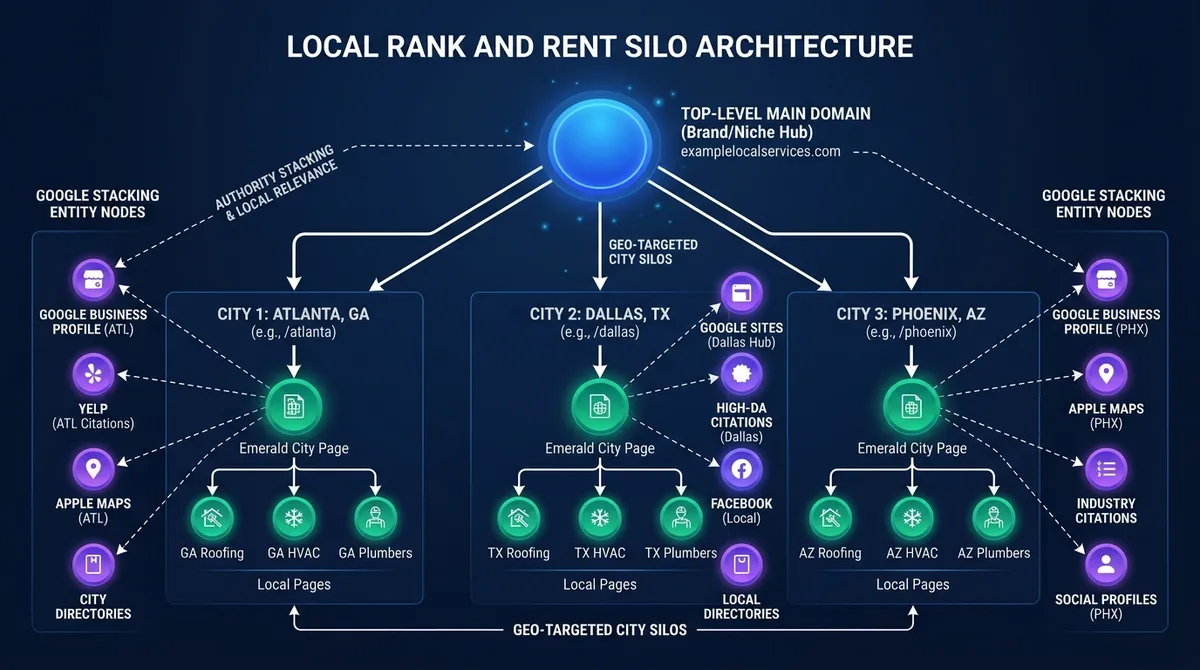
Rank & Rent local SEO link strategy relies on a 2-tier architecture: Tier 1 builds NAP-consistent entity trust across local chambers, Google Business, and Apple Maps; Tier 2 builds city-specific silo links that pass geographic relevance to target location pages without diluting root domain authority.
⚡ Key Takeaways at a Glance
- Rank & Rent websites must build localized entity links per city silo rather than pointing all links to the homepage.
- Google Map embeds and structured LocalBusiness Schema co-occurrences supercharge local organic rankings.
- Automated nightly health checks ensure client-rented assets never suffer from silently deleted backlinks.
Rank and Rent is one of the most profitable business models in search engine optimization: you build a localized lead generation asset, rank it in the Google Top 3 for high-intent trade services (roofing, plumbing, tree removal), and rent the exclusive leads to local business owners for $1,000 to $3,000 per month. The bottleneck has always been link execution speed across multiple cities.
1. The Rank & Rent Economics Flywheel
Unlike client SEO where you trade hours for dollars, Rank & Rent assets are owned media. If a contractor stops paying rent, you simply forward the phone number and lead forms to their competitor across town. To scale a portfolio to 20+ rented assets, your link building workflow must be templated into daily 10-minute execution blocks. The traditional agency model requires constant client management, reporting meetings, and convincing business owners to invest in long-term campaigns. Rank and rent flips this script entirely by offering a finished, lead-generating product. You own the domain, the Google Business Profile, and the tracking phone numbers. The secret to scaling this model is leveraging high-velocity, low-cost link acquisition. Because local search algorithms are significantly less competitive than national commercial keywords, a highly structured entity network combined with 10 to 15 authoritative Web 2.0 citations is usually enough to secure a top 3 position.
2. City Silo Architecture & Internal Link Flow
Structure your site into strict geographic directories: /atlanta-roofing/, /dallas-roofing/, /phoenix-roofing/. When building external backlinks, point city-specific citations and Web 2.0 articles directly to that city’s landing page. Never cross-link city silos horizontally; only link vertically back up to the master state or service hub. This strict vertical silo prevents geographic relevance from bleeding across your site. If Googlebot crawls a Dallas roofing page and finds a footer link to a Phoenix roofing page, it dilutes the geographic certainty of the domain. Instead, use a localized breadcrumb architecture. Each city page should internally link up to a State Hub (e.g., /texas-roofing/), which then links to the homepage. When you acquire a high-power link to the Dallas page, the PageRank flows smoothly up the silo, raising the authority of the entire geographic cluster without causing topical confusion.
| Target Page | Link Source | Anchor Strategy | Target Impact |
|---|---|---|---|
| /dallas/ (City Hub) | Dallas Chamber of Commerce (DR 82) | Branded ("Dallas Roof Experts") | Local Map Pack #1 |
| /dallas/metal-roofing/ | Medium Technical Guide (DR 96) | LSI ("metal roof installation dallas") | Organic #1 for High-Ticket Query |
| Homepage | Crunchbase & About.me (DR 90+) | Naked URL | Domain Authority Baseline |
3. Local Google Entity Stacking Protocol
Google Entity Stacking uses Google’s own high-trust properties (Google Sites, Google Drive Sheets, Google My Maps) to establish an unassailable entity footprint. Because Google will never penalize its own domains, you can embed your NAP info, city service keywords, and target URLs into a public Google Site to pass massive topical trust. The architecture of a Google Stack is simple but devastatingly effective. Create a public Google Drive folder containing a Google Sheet with your business hours, a Google Doc with your services, and a customized Google My Map pinning your service areas. Embed all of these assets into a single public Google Site. Finally, point your Phase 2 Web 2.0 links at the Google Site rather than your money site. This filters the link juice through Google’s own domain, stripping away any potential spam signals while passing 100% of the localized PageRank directly to your Rank & Rent asset.
4. Automated Client Reporting & White-Label Audits
Local contractors do not care about raw backlink counts—they care about phone calls and ranking velocity. Use automated white-label PDF reports that showcase Google Search Console clicks, live verified links, and month-over-month Top 3 ranking progress. In the Rank and Rent space, your primary metric of success is the cost-per-lead generated versus the monthly rent charged. By automating your reporting stack with tools like RankRoot, you can send automated weekly digests to your renters proving the asset’s value. These reports should highlight impression growth, exact keyword positions, and the exact number of phone calls generated via your call tracking software. Providing transparent, indisputable ROI data makes the rental contract extremely sticky, ensuring you generate passive income from the asset for years to come.
Frequently Asked Questions (FAQ)
How many backlinks does a local Rank & Rent site need to rank in the Top 3?
Most local service niches in low-to-medium competition cities (population 50K–250K) require only 15 to 30 high-DA foundational entity citations and 3 to 5 contextual Web 2.0 links to capture Top 3 map and organic rankings.
What is the best anchor text for local Rank & Rent pages?
Use 60% Brand Name, 25% Naked City URL, and 15% Geo-targeted LSI (e.g. "Dallas roofing contractor"). Avoid spamming exact match search terms without brand co-occurrence.

Founder and Lead SEO Architect at RankRoot. 10+ years scaling organic visibility, authority entity engineering, and penalty-immune backlink roadmaps.
Ready to Automate Your 90-Day Ranking Blueprint?
Execute your 10-minute focus mission each day. Generate safe AI anchor text, monitor 404 dead links, and climb into the Top 3.